BALANCING THE GRID WITH ONE MACHINE
One machine. One Power Take-Off. Two complementary energy functions.
Generate when the grid needs power. Store when it needs flexibility.
GENERATION MATTERS. FLEXIBILITY IS KEY.
As renewables grow, the challenge is not only how much clean energy we can generate. It also matters how the system responds when energy is available and when it is needed.
ONE MACHINE. TWO COMPLEMENTARY FUNCTIONS.
ESWave proposes one physical platform that switches between generation and storage according to energy-system needs. One machine and one shared Power Take-Off for two complementary functions.
When the grid needs power
Generate: deliver useful energy to the system.
When energy is available to store
Absorb and retain energy to release it when it is more useful.
TWO COMPLEMENTARY FUNCTIONS.
ONE SHARED NEED: BALANCING THE SYSTEM.
Integrating both functions from the outset can reduce duplication and coordination work. The support structure and connection remain part of the investment; savings must be assessed for each project.
WHAT GOES UP DIFFERS FROM WHAT GOES DOWN.
TWEFDA explores an energy conversion mechanism, within known physical laws, in which the converter behaves differently during ascent and descent.
On the way up
The system adopts a lower-weight state.
On the way down
The system adopts a higher-weight state.
Weight-Changing Energy is at the computational proof-of-concept stage. Preliminary simulations indicate potential to improve capture compared with a fixed-weight configuration. Physical validation is the next decisive step.
An improvement of this kind could contribute to the commercial viability of wave energy. Detailed technical information is provided through controlled access, subject to an NDA and the applicable permissions.
WaveAmp opens the first European commercial route for WCE.
FOUR APPLICATIONS. ONE MACHINE.
One ESWave and a single Power Take-Off provide a common physical platform for four renewable energy applications.
Wave energy
Generation from relative motion between the sea surface and a fixed reference.
Weight-Changing Energy
Non-reciprocal energy conversion through changes of state between ascent and descent; pending physical validation.
Offshore Pumped Hydro
Mechanical energy storage as gravitational potential in the ocean.
Tidal Range Energy
Energy release coordinated with changes in tidal level.
THE RIGHT FUNCTION AT THE RIGHT TIME.
The control architecture determines what to do, when to do it and how to change the asset's function according to available energy and the system's needs.
Balancing is no longer solely a problem for the grid to solve: the asset is designed to contribute to the system's response.
A single Power Take-Off changes function according to conditions. Commercial provision of grid services requires the corresponding configuration, validation and contracts.
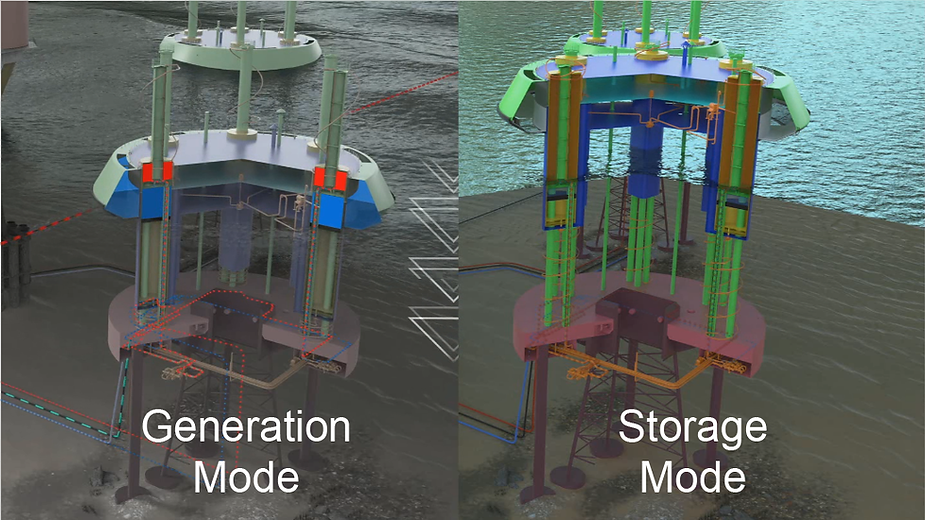
HOW IT WORKS: GENERATION AND STORAGE.
See how one machine generates, switches mode and stores energy. Explore the video stages or listen to the synchronised explanation.
TWEFDA HUB: CONNECT TO SHARE.
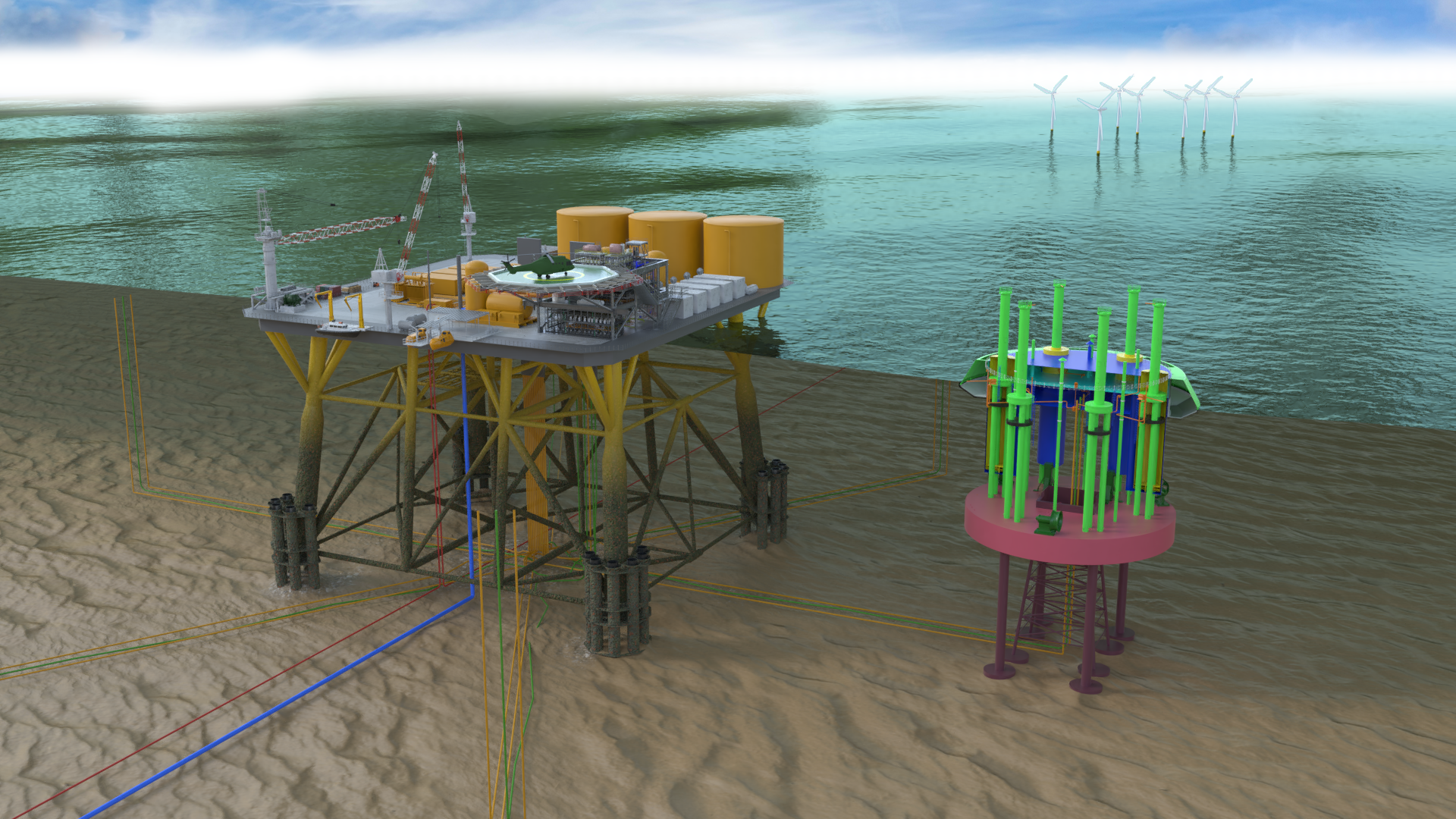
The TWEFDA Hub provides a common connection point for generation, storage, consumers and the grid. It enables energy flows to be coordinated and infrastructure to be shared according to the project configuration.
Connect close to the asset
A common offshore point can change where each asset connects to the wider energy system.
Integrate and direct flows
The Hub configuration allows generation, storage and consumers to connect, as well as other networks or hubs.
Available connections and functions depend on the project configuration and existing infrastructure.
FROM GENERATE OR STORE TO GENERATE AND STORE.
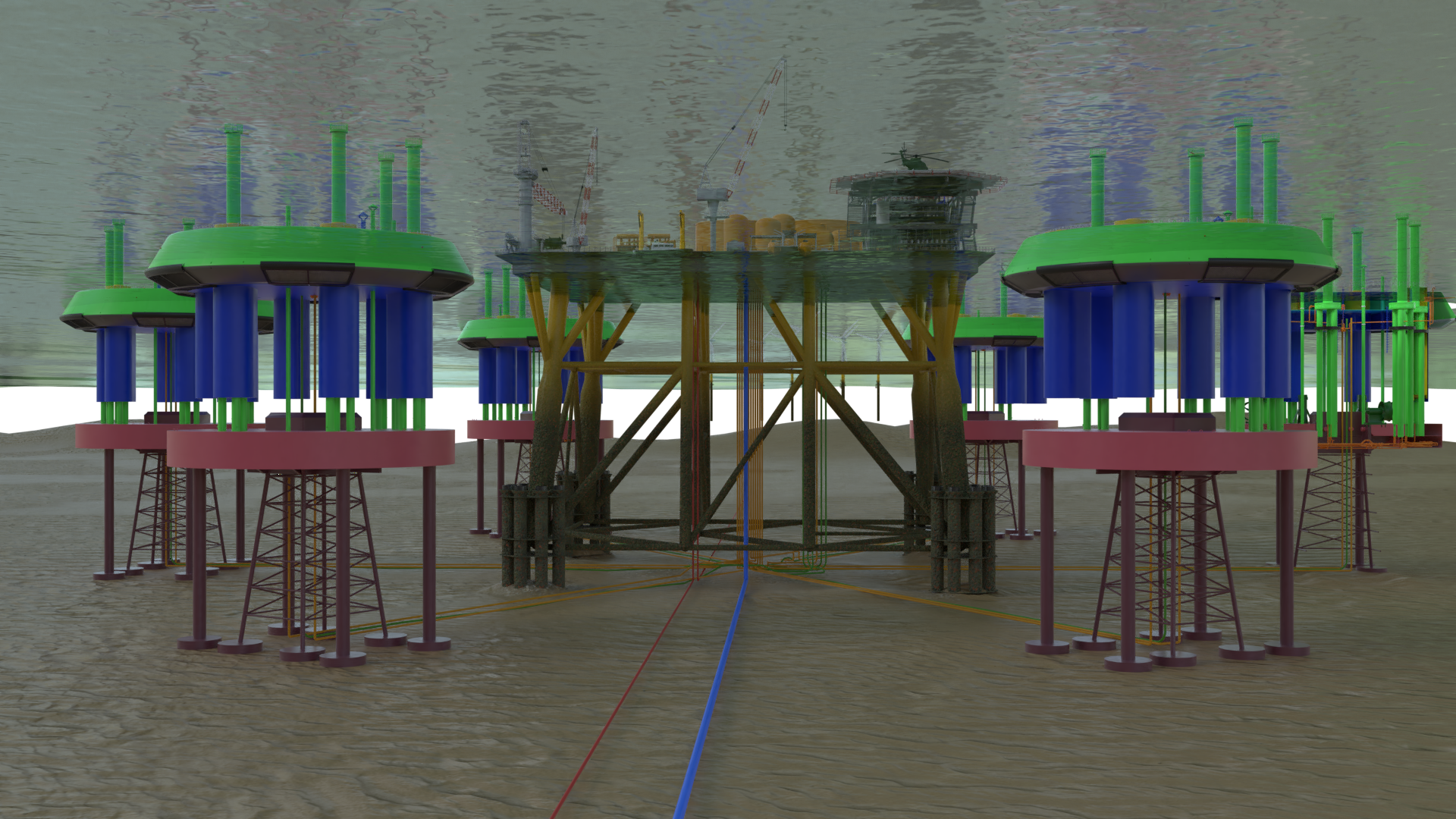
A TWEFDA Association coordinates six ESWaves. Some can generate while others store: different functions managed as one energy system.
Coordination allows functions to be distributed between units according to system conditions. Management is integrated from the design stage: the Association is conceived as an ad hoc solution within a single project.
At the same time, through units performing different functions.
TIME BECOMES AN ENERGY RESOURCE.
The value of energy depends on how much we have and when it is available. Being able to store it and release it at another time adds a new dimension to its management.
The economic outcome depends on prices, losses, costs and the project's operating conditions.
LCOCEOS: VALUING A MACHINE THAT GENERATES OR STORES.
Conventional metrics allow generation and storage to be analysed separately. ESWave shares its machine, Power Take-Off and some costs between both functions. Evaluating it requires considering that architecture and how it uses its time.
Levelised Cost Of Combined Energy Or Storage. TWEFDA proposes LCOCEOS as a framework for a joint assessment of an asset with complementary functions.
Compare LCOE, LCOS and LCOCEOS
| Metric | What it analyses | What it contributes to this assessment |
|---|---|---|
| LCOE | The levelised cost of generating electricity over the project's lifetime. | Helps analyse generation. The storage function and shared costs require explicit treatment. |
| LCOS | The levelised cost of storage relative to the energy it delivers. | Helps analyse storage and discharge. Previously charged energy is not new generation. |
| LCOCEOS | TWEFDA's proposal to jointly evaluate generation OR storage in a shared asset. | Proposes considering common costs, choice of function and allocation of operating time. |
One machine. Different uses of its time.
- GENERATECapture wave energy.
- STOREAbsorb and retain energy.
- RELEASEReturn previously stored energy.
- WAITRemain locked until release.
Calculating a value requires defining lifetime, system boundaries, shared and specific costs, charging energy, losses and operating profile. LCOCEOS is a TWEFDA proposal; the original article does not establish a closed formula or a calculated value. It is not obtained by adding LCOE and LCOS.
INSTALLATION AND MAINTENANCE.
A machine designed to arrive afloat, connect to its support and return to shore. Mobility is part of how ESWave is installed, maintained and protected.
Major maintenance can be carried out onshore.
When a major intervention requires it, ESWave can be disconnected and towed to port. After the work, the machine can return to its location.
PROTECTION ON SITE. SHELTER WHEN NEEDED.
Two complementary responses: raise and ballast the machine at its location, or remove it preventively before an extreme event.
Raise and ballast.
The design envisages raising ESWave approximately 15 metres above the ocean surface and ballasting it with seawater to increase its stability.
Anticipate and seek shelter.
Buoy data, satellite information and weather forecasts can support the decision to disconnect exposed ESWaves and tow them to a safe location.
A harbour of refuge would allow units to remain sheltered during the extreme event and support their subsequent return.
Design strategy. Survival limits and disconnection and towing windows require validation for each configuration and location.
MOVING THE MACHINE CHANGES WHERE IT CAN BE USEFUL.
Redistribute units.
The ability to exchange ESWaves between locations allows the arrangement of assets to adapt to production and maintenance needs.
Bring energy to a prepared location.
A prepared location with a jacket and a connection to a portable hub could receive a towed ESWave to supply marine electricity during reconstruction after an earthquake, provided the infrastructure remains usable.
A SECOND LIFE FOR MARINE INFRASTRUCTURE.
Existing infrastructure can offer new possibilities where reuse is technically, economically and regulatorily viable.
Reuse
Retain structures that can still be useful.
Repurpose
Give offshore locations a new energy role.
Reconnect
Turn infrastructure into an interface for new energy flows.
Extending the useful life of selected structures can preserve options for new technologies. Reuse depends on each location and does not remove applicable decommissioning obligations.
TWEFDA: TECHNOLOGY, HISTORY AND COMMERCIALISATION.
The story that began with one word — BALANCE — now connects machines, functions, coordinated systems and maritime infrastructure.
TWEFDA and WaveAmp
TWEFDA retains global ownership of the technology and intellectual property platform. WaveAmp is the European commercial route for Weight-Changing Energy, through a licence limited by field of application.
Technology platform and intellectual property.

European commercial route for WCE.
The human story
TWEFDA began by asking whether problems, waste and infrastructure at the end of its life could become resources. That idea continues to connect the technology with future generations.
INVESTMENT OPPORTUNITY
ONE TECHNOLOGY.
MANY LICENCES.
REVENUE THAT CAN RECUR.
Investing in WaveAmp means backing technology with the potential to accelerate the wave energy market.
If technologically validated, Weight-Changing Energy could open the door to a new renewable energy source, expanding opportunities for knowledge, technological development and new markets.

THE POTENTIAL IS LARGE.
THE RISK IS REAL.
This is a high-risk investment. The technology requires validation and its commercial development may not achieve the expected results.
You could lose some or all of your invested capital. Revenue, profits and investment returns are not guaranteed.
Each new licence can open a new revenue stream. Each commercial deployment can sustain royalties.
WaveAmp is the first commercial step for Weight-Changing Energy in Europe. The potential lies in bringing one technology to multiple projects through licences and royalties.
Weight-Changing Energy
European commercial route
+ royalties
New agreements.
Revenue linked to commercial use.
Commercial model outline. Its development depends on technological validation, agreements and project deployment.
What if your next step was to take part?
The investment goes into WaveAmp.
TWEFDA participates as a shareholder and retains ownership of the intellectual property.
Discover the model, the structure and the next step.
CHOOSE YOUR NEXT STEP.
Generate when energy is needed. Store when it is available. Connect assets. Give existing infrastructure a new purpose.